Taṣawwuf is a commonly misunderstood concept among many Muslims, especially in recent times. Let's clarify a few things about what taṣawwuf actually is and whether it is compatible with the orthodox, Sunni Islam.
Friday, 16 December 2016
Tasawwuf: a Legitimate Part of Islam?
Taṣawwuf is a commonly misunderstood concept among many Muslims, especially in recent times. Let's clarify a few things about what taṣawwuf actually is and whether it is compatible with the orthodox, Sunni Islam.
Thursday, 28 July 2016
Exam Tips from Qur’anic and Prophetic Wisdom
1) It's not the end of the world. Things could've gone worse. Would you prefer getting a bad exam mark or having an accident on the way to school that leaves you paralysed for life?
2) Allah tells us in the Qur’ān,
Wednesday, 27 July 2016
Finding the Qiblah Using a Smartphone
Saturday, 23 July 2016
Seeking Divine Love?
Many people ask: how can I attain the love of Allah and closeness to Him?
Allah Himself answers this question in numerous places in the Qur’ān when describing the attributes of those whom He loves.
“Then, when you have decided on a course of action, put your trust in Allah: Allah indeed loves those who put their trust in Him.” (Qur’ān 3:159)
who strive in Allah’s way without fearing anyone’s reproach. Such is Allah’s favour. He grants it to whomever He wills. Allah has endless bounty and knowledge.” (Qur’ān 5:54)
He also describes for us that which distance one from His love.
“O you who believe! Do not forbid the good things Allah has made lawful to you – do not exceed the limits: Allah indeed does not love those who exceed the limits – but eat the lawful and good things that Allah provides for you. And fear Allah, in whom you believe.” (Qur’ān 5:87-88)
Furthermore, there is a ḥadīth qudsī in which Allah informs His slaves the of road to His Love and Closeness:
As such, the path to attaining Allah's Love and Closeness entails:
- First and foremost, fulfilling all of the obligations (farā’iḍ) He has ordained for us and refraining from that which He has prohibited (muḥarramāt) for us.
- Further adding on to the above by performing voluntary acts of obedience and virtue (nawāfil) for Him (it's foolish to prioritise the nawāfil over the farā’iḍ – that's just like placing salt, pepper, and sauce onto chips which are still frozen).
- Striving to attain the character traits of those whom Allah loves as described in His book. This entails constantly turning to Him in repentance, keeping oneself clean, following the sunnah, being patient, relying upon Allah, and so on.
- Striving to purify oneself of the character traits which Allah dislikes as described in His book. This entails purging one's heart of arrogance, boastfulness, treachery, ungratefulness, evil-doing and so on.
In simpler terms, it's by following the sharī‘ah, prioritising what it prioritises.
And what is the result? I become the hearing by which he hears; the seeing by which he sees; the hands by which he strikes; and the legs by which he walks. That is, Allah becomes the protector of our limbs and organs, such that our limbs and organs will only do that which is well-pleasing and beloved unto Him; our limbs and organs are protected from sin and all that which is unbecoming. Not only that: Were he to ask Me, I would indeed grant him. And were he to seek refuge in Me, I would indeed grant him refuge. How amazing! Allāhu akbar!
Saturday, 7 May 2016
Configuring Your Prayer App – Part II
In the previous post, we stated that the time for ‘Ishā’ starts when the white twilight that trails the setting Sun disappears below the horizon. However, there is actually a noteworthy difference of opinion on this matter (just like there is for the ‘Aṣr prayer). The difference of opinion relates to whether ‘Ishā’ starts with the disappearance of the white twilight (al-Shafaq al-Abyaḍ) or the red twilight (al-Shafaq al-Aḥmar).
According to Imam Abū Ḥanīfah (Allah have mercy on him), ‘Ishā’ starts with the disappearance of the white twilight, which is the definition we've been working with so far. However, according to the Mālikī, Shāfi‘ī, and Ḥanbalī madh'habs, ‘Ishā’ actually begins with the disappearance of the red twilight from the horizon; this is also the view of Imam Abū Hanīfah's two disciples, Imam Abū Yūsuf and Imam Muḥammad al-Shaybānī (Allah have mercy on them both). Consequently, the latter view is in fact the majority view. However, most – if not all – prayer calendars and apps give the ‘Ishā’ time based on the former view, i.e. the view of Imam Abū Ḥanīfah that ‘Ishā’ starts with the disappearance of the white twilight.
This is a very important fact to note for those who do not follow the Ḥanafī school. Important because for the majority, Maghrib actually ends before the ‘Ishā’ time given by your prayer app or calendar. Thus, if you were to delay your Maghrib prayer up until just 20 minutes prior to the ‘Ishā’ time given by your prayer app, you'd actually be praying Maghrib outside its time – and remember that it is sinful to delay a prayer without a valid shar‘ī excuse.
So you might ask: how do I configure my app to display the ‘Ishā’ time as per the majority opinion?
Here, things get a bit tricky. First of all, you need an app where you can actually customise the Fajr and ‘Ishā’ angle. For Android, there's the Prayer times: Qibla & Azan app; for iOS, there's the alQibla app.
Thereafter, set the ‘Ishā’ twilight angle as being 13.5°. This applies for most of the year, except from around early May until around late August, when a 14.5° angle should be used instead. (From late April until early May, the red twilight angle gradually changes from being 13.5° to being 14.5°. Then, from early to late August, it gradually changes again from being 14.5° to being 13.5° again.)
Here's a demonstration with screenshots for the Android Prayer times: Qibla & Azan app:
And here's a demonstration with screenshots for the iOS alQibla app:
Remember that from early May to late August, an angle of 14.5° is used instead. And don't forget to also configure your Fajr twilight angle! (To 18°, that is. Not 13.5° or 14.5°. There's no difference of opinion among the jurists about when Fajr time starts.)
Also note that these figures of 13.5° and 14.5° are specific to Sydney, Australia. Other regions may/will have their own respective figures. (The more common angle at which the red twilight sets for many regions is in fact 12°.)
Two more notes:
1. Ḥanafīs should nevertheless avoid delaying Maghrib past the "red twilight" (al-Shafaq al-Aḥmar) ‘Ishā’ time such that they pray it just before the "white twilight" ‘Ishā’ time enters. This is due to:
(a) precaution
(b) the fact that many Ḥanafī scholars have held that it is in fact the disappearance of the red twilight that defines the start of ‘Ishā’, this being the stronger position in the madh'hab according to them.
2. Non-Ḥanafīs should nevertheless delay ‘Ishā’ until the "white twilight" (al-Shafaq al-Abyaḍ) time enters, due to:
(a) precaution
(b) this being mandūb (recommended) by the sharī‘ah (at least in the Shāfi‘ī madh'hab).
BUT I'M NOT BOTHERED HAVING TO CHANGE MY PRAYER APP SETTINGS EVERY NOW AND THEN
With regards to all that has been mentioned about ‘Ishā’ according to the majority of the schools actually starting before the time your average prayer app or calendar says it does, yes, all that configuration about twilight angles and degrees can be a bit confusing, not to mention having to explain to others why your phone's ‘Ishā’ adhān goes off half-an-hour before everyone else's.
If you don't want to go through all the hassle, what you can do is just simply set your app's calculation method to the University of Islamic Sciences, Karachi method, and then ensure that you pray Maghrib as soon as possible (something you should be doing anyway as the aḥādīth especially emphasise performing Maghrib as soon as its time enters) and that you don't delay it to within 30-40 minutes of the ‘Ishā’ time as given by your phone app using the University of Islamic Sciences, Karachi method. That way, you guard your Maghrib, guard your ‘Ishā’, and avoid the hassle of having to tweak around with settings every now and then.
Hopefully, this has clarified some confusion with regards to all those settings on your prayer app, as well as with regards to the actual end of Maghrib and start of ‘Ishā’. If not, please do not hesitate to comment.
We ask Allah to make us of those who guard their prayers, both in quantity and quality.
And Allah knows best, and with Allah lies ultimate success.
Saturday, 19 March 2016
Configuring Your Prayer App
Chances are that you've got an app on your phone to give you the times of the five daily prayers. But have you got it configured correctly? What if the whole time your prayer app was configured incorrectly and so it turns out that you've been praying at the wrong time for all these years?
Pretty important then that you've got your settings configured correctly, isn't it?
So you open your phone's flashy prayer app. You then go to the settings to set your location. But then you're greeted with a whole bunch of other options:
- Calculation method: ISNA, Muslim World League, Umm al-Qura, etc.
- ‘Aṣr method: Standard vs Ḥanafī
- Minutes adjustment
- etc.
So how do we go about with all these settings? Read on to find out.
I JUST WANT TO SET UP MY APP. I DON'T CARE ABOUT ALL THE TECHNICALITIES.
If all you're worried about is setting up your app to give you accurate prayer times, then adjust your app's settings as follows.
Calculation Method (Fajr and ‘Ishā’ Method)
Use the University of Islamic Sciences, Karachi method.
(Generally, this method is the one to use for most places around the globe – Sydney, Australia included. However, in various other regions around the globe, a different method[s] would need to be used.)
‘Aṣr Method
This depends on the madh'hab you follow (read this if you have no clue what a madh'hab is). If you follow the Ḥanafī madh'hab, use the Ḥanafī option (applies mostly, though not exclusively, to those from the Indian subcontinent and the Afghan region). For those who follow one of the other three madh'habs, use the Standard option (your app may call it something like the "Shāfi‘ī" or the "Shāfi‘ī, Mālikī, Ḥanbalī" option).
Minutes Adjustment
For Ẓuhr, adjust it by at least +3 minutes (many suggest +5 minutes; this is safer).
For Maghrib, also adjust it by at least +3 minutes..
OK, COOL. BUT WHY THESE SETTINGS?
Hmm. So you are curious, eh? Read on.
Calculation Method (Fajr and ‘Ishā’ Method)
So you might be asking: why the University of Islamic Sciences, Karachi method?
First of all, let's look at how the sharī‘ah has defined the entry times of Fajr and ‘Ishā’. The time for Fajr is said to start at al-Ṣubḥ al-Ṣādiq (true dawn), i.e. when the sky around the horizon begins to grow light. In other words, Fajr starts with the appearance of the white dawn twilight. The time for ‘Ishā’, meanwhile, is said to start when the white dusk twilight (more discussion on the white twilight later on) that trails the setting Sun disappears below the horizon. (Just to put things into perspective, three different twilights trail the Sun as it sets, as stated by our Islamic scholars: a red twilight, a yellow twilight, and a white twilight. ‘Ishā’ starts when the white twilight sets.)
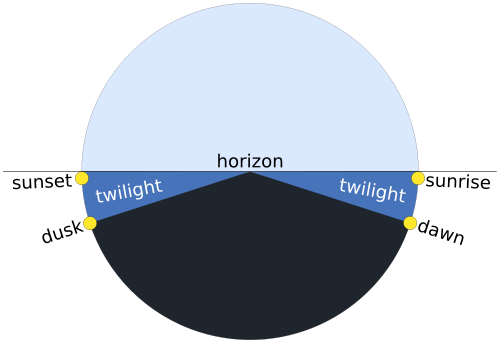
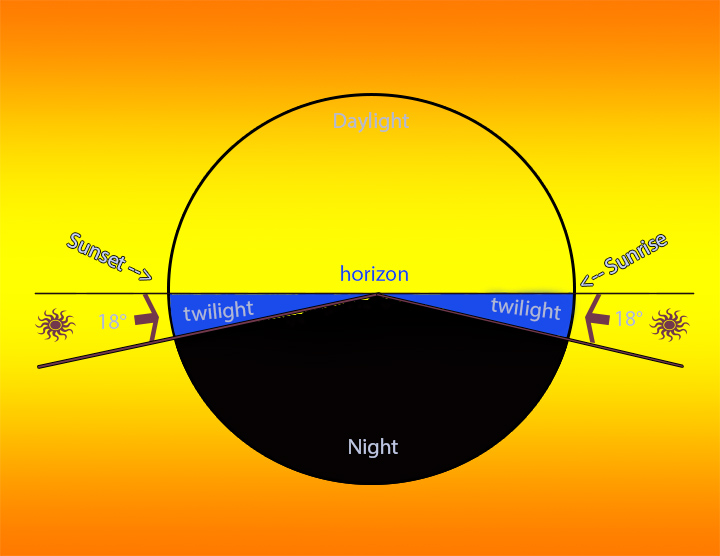
Now, astronomers can calculate when both al-Ṣubḥ al-Ṣādiq and the setting of the white twilight occur. They do this by calculating the angle between the centre of the Sun's disc and the horizon. Now, for most regions of the world, the angle at which both al-Ṣubḥ al-Ṣādiq and the setting of the white twilight occur is 18°, i.e. both al-Ṣubḥ al-Ṣādiq and the setting of the white twilight occur when the centre of the Sun makes an angle of 18° with the horizon. These two diagrams both illustrate it well.
Going back to all those different calculation methods, the reason there are several calculation methods on your app is because several institutions have determined different angles at which both al-Ṣubḥ al-Ṣādiq and the setting of the white twilight occur, based on which figures they deem most correct. For example, the "Egyptian General Authority of Survey" method has Fajr and ‘Ishā’ start when the Sun's centre is 19.5° and 17.5° respectively below the horizon, while the "Muslim World League" method has ‘Ishā’ start at an angle of 17°. Although these figures may be used for certain parts of the world, they can't be used for all – Sydney definitely included. Meanwhile, the only calculation method out of the whole lot that has both al-Ṣubḥ al-Ṣādiq and the setting of the white twilight occur at 18° is the "University of Islamic Sciences, Karachi" method. Accordingly, this is the one you should configure your prayer app to.
‘Aṣr Method
So you might be asking: why are there two different ‘Aṣr calculation methods?
It all goes back to the difference of opinion amongst the fuqahā’ (jurists) on when the time for ‘Aṣr enters. According to the Mālikī, Shāfi‘ī, and Ḥanbalī schools, ‘Aṣr time starts when the length of an object's shadow, in addition to the length of its shadow at the time of zawwāl, equals the object's height. However, according to the Ḥanafī school, ‘Aṣr time starts when the length of an object's shadow, in addition the length of its shadow at the time of zawwāl, is double the object's height. For example, say we stood up a 30 cm ruler on the ground outdoors and its shadow at the time of zawwāl was 5 cm. According to the majority opinion, ‘Aṣr would start when the shadow of the ruler reaches 35 cm in length (30 cm + 5 cm), while according to the Ḥanafi opinion, ‘Aṣr would start when the shadow of the ruler reaches 65 cm in length ((30 cm × 2) + 5 cm).
As such, there are two methods for calculating ‘Aṣr, depending on which opinion you follow.
Minutes Adjustment
So you might be asking: why do I need to adjust the minutes for Ẓuhr and Maghrib?
Let's address Ẓuhr first. Ẓuhr is defined as starting when the Sun begins to decline from its zenith (i.e. its highest point in the sky for the day). Now, the thing with your prayer app is that when it comes to Ẓuhr, it actually calculates the time when the Sun is actually at its zenith, not when it begins to decline from it. This can be problematic: it is actually ḥarām/makrūh taḥrīman, and therefore sinful, to offer ṣalāh when the sun is at its zenith. Furthermore, since Ẓuhr time starts when the Sun declines from its zenith, if one were to therefore begin praying right when the Sun is at its zenith, one's prayer would be invalid as one began performing it before its time. The same applies with the pre-Ẓuhr sunnah prayers.
Obviously, what all that means is that we need to wait a few minutes after the Sun reaches its zenith before we can pray Ẓuhr. Now, long story short, the Sun can be said to first decline from its zenith 65 seconds after reaching its zenith. Round that forward to the next minute and you get two minutes. (Yes, we round to the next minute here, not the nearest minute - try figuring out why.) However, an extra one minute should be added as a safety factor, for various reasons. Thus, the Ẓuhr time on your prayer app should be adjusted so as to reflect this. Adding three minutes to the time calculated by your app is the minimum, though it is safer to add at least five minutes, as recommended by various scholars and Islamic authorities.
As for Maghrib:
"Maghrib should be calculated at least as 3 minutes after theoretical sunset (reported in newspapers) for the following considerations:
1. The effects of actual humidity, temperature, and pressure in the atmosphere may cause a different refraction of sun light than assumed in calculations of theoretical sunset.
2. In some areas there could be a downward sloping ground towards western horizon that causes a delayed sunset for an observer compared to a perfectly level ground as assumed in calculations of theoretical sunset.
3. For major metropolitan cities, the sunset in a 30 mile (approx. 48 km) radius from the point assumed in calculation will vary. Since the people may live all around the city, this may delay sunset for some areas." (Adapted from moonsighting.com)
A VERY IMPORTANT NOTE ON ‘ISHĀ’
Earlier, we stated that the time for ‘Ishā’ starts when the white twilight that trails the setting Sun disappears below the horizon. However, there is actually a significant difference of opinion amongst the fuqahā’ on this matter (just like there is for ‘Asr prayer). The difference of opinion relates to whether ‘Ishā’ starts with the disappearance of the white twilight (al-Shafaq al-Abyaḍ) or the red twilight (al-Shafaq al-Aḥmar).
The implications of this difference opinion are quite significant: for those who hold that ‘Ishā’ time enters with the disappearance of the red twilight, whatever was mentioned about the University of Islamic Sciences, Karachi calculation method being the correct method to use now falls flat on its face, as this method (the other methods likewise) works on the basis that ‘Ishā’ time enters with the disappearance of the white twilight. Not only that, but the majority of the schools of fiqh actually hold the red-twilight opinion to be the correct and relied-upon opinion.
This dilemma will be dealt with in more detail in the upcoming post, in shā’ Allāh.
In shā’ Allāh, this has clarified some confusion with regards to all those settings on your prayer app. If not, please do not hesitate to reply and ask.
We ask Allah to make us of those who guard their prayers, both in quantity and quality.
And Allah knows best, and with Allah lies ultimate success.
Friday, 18 December 2015
Displeasure with the Divine Decree
God-conscious people, when asked about what their Lord has given them, say that all of it is good. They say this out of knowledge of the nature of this world, as a temporary crucible of trial and purification. Because of this elevated understanding, they are patient with afflictions and trials. For worldly people, there is only this world, and this understanding creates a blind spot to the wondrousness of God’s creation and His signs strewn throughout.
There are only four possible states in which the human being can live, according to revealed sources. A person is either receiving blessings (niʿmah) or tribulations (balā’) from God; or is either living in obedience (ṭāʿah) to God or in disobedience (maʿṣiyyah). Each condition invites a response. When God bestows blessings, the response should be gratitude in all of its manifestations. According to sacred law, gratitude is expressed first by performing what is obligatory (wājib), and then going beyond that by performing virtuous, recommended (mandūb) acts. Gratitude is an awakening of appreciation in one’s heart and an acknowledgement of what one has received. Abusing one’s material assets (hoarding them without consideration of the needy or applying them toward forbidden matters) is a flagrant act of ingratitude.
The response to tribulation is patience (ṣabr), as well as steadfastness and resolve. This is what God demands from people in times of trial—“a beautiful patience,” as close as possible to the what Jacob (may peace be upon him) exhibited in response to the disappearance of his beloved son Joseph (may peace be upon him) and the machinations of his other sons (qur’an , 12:18), or to the patience of Job (may peace be upon him) during his afflictions.
As for obedience, one must recognize that obedience is a blessing from God. If a religious person starts to believe that he is better than other people—even if these “other” people are in the state of disobedience—he invites haughtiness. This is the danger of obedience and, in fact, the danger of religion: self-righteousness. Imam Ibn ʿAṭā’allāh said, “How many a wrong action that leads to a sense of shame and impoverishment before God is better than obedience that leads to sense of pride and arrogance!” In this is the secret of wrong actions. The New Testament relates the story of the pride of the righteous Pharisee and the contrition of the humble tax collector. Jesus (may peace be upon him) remarks, “Those who make themselves great will be humbled, and those who humble themselves will be made great.” Sīdī Aḥmad Zarrūq said that the goodness in obedience is in its essence, and the evil in obedience is what it can result in. This does not mean that there is evil in obedience and goodness in disobedience. Rather, Sīdī Aḥmad Zarrūq points out the danger of obedience creating vanity in one’s heart, an aura of sanctimony and condescension. On the other hand, when one indulges in wrongdoing and is overcome with feelings of shame, this can inspire him to hasten to repentance. The Prophet ﷺ said that he feared for his people the vanity of self-righteousness.
The Prophet ﷺ also said that whoever has a mustard seed of arrogance in his heart will not enter Heaven; this sentiment is shared with Christianity. What God asks from obedient people is simply acknowledging that their obedience is a gift from God. The Prophet ﷺ said, “Do not find fault in others. If you find fault in them, God may take their faults away and give them to you.” It is unbecoming for a believer to look with scorn at those in tribulation and exhibit a loathsome disdain toward others who seem misguided. It is far better to come with compassion toward them and gratitude to God. When the Prophet ﷺ saw people severely tried, he made the supplication: “Praise be to [God] who has given me wellbeing such that I was not tried like these people. And He has preferred me over so much of his creation.” When the Prophet ﷺ witnessed people in tribulation, he responded with compassion for them and gratitude for wellbeing.
When it comes to disobedience (maʿṣiyyah), the correct response is sincerely repenting to God (tawbah); seeking His forgiveness, pardon, and mercy; feeling remorse for past sins; and having the resolve never to sink into disobedience again.
Everything that can happen to a person falls into one of these four categories, and each invites an appropriate response. What comes to a person in his or her life may help a person move closer to God when the response is right: “It may be that you dislike something, though it is good for you. And it may be that you love something, though it is bad for you. And God knows, and you do not know” (qur’an , 2:216). Ibn ʿAbbās said that if a person is tested with a tribulation, he will find in it three blessings: firstly, the tribulation could have been worse; secondly, it was in worldly matters and not in spiritual ones; and thirdly, it came in the finite world and not the infinite one. All these are reasons to thank God even for tribulations.
It is important to look at the life of the Prophet ﷺ and to recognize that no one faced greater tribulation. The Prophet ﷺ lived to see all of his children buried, except for Fāṭimah (may God be pleased with her). How many people experience that in their lifetime? Out of six children, he saw five of them perish. His father died before his birth. His mother died when he was just a boy. His guardian grandfather then died. When he received his calling, he saw his people turn against him with vehemence and brutality. People who had once honored him now slandered him, calling him a madman, liar, and sorcerer. They stalked him and threw stones until he bled. They boycotted him and composed stinging invectives against him. He lost his closest friends and relatives, like Ḥamzah (may God be pleased with him). After 25 years of blissful marriage, his beloved wife, Khadījah (may God be pleased with her), died during the Prophet’s most trying times. Abū Ṭālib, his protecting uncle, also died. The Prophet ﷺ was the target of thirteen assassination attempts. How many people have faced all of that? Not once in a single hadith is there a complaint from him— except when beseeching his Lord.
To be displeased at God’s divine decree is to plunge into heedlessness (ghaflah). In his book al-Furūq, Imam al-Qarāfī distinguishes the difference between a divine decree and being content with the decree itself. Should people be happy with all that comes their way, including the bad things? God has decreed that evil exist in the world in order to test humankind and for reasons that accord with His wisdom. We should not be displeased with His choice in allowing this. But when one sees societies plunged into immorality, it is not something to be pleased with or even to feel indifferent toward. On the contrary, God requires that we dislike it. But never should we resent or be displeased with the fact that God has created a world wherein such things exist, however unpleasant they may be. As Ibn ʿAbbās said, every trial could have been worse, such as if it involved one’s worldly affairs rather than religion, and if it came in this world and not the Hereafter, which lasts forever.
Imam al-Qarāfī gives the example of a physician who amputates the arm of a patient who had gangrene spreading out of control. One day, the physician overhears the patient complaining that the physician was ignorant for amputating his arm. The physician is offended, for he saved the man’s life. Had the physician heard the patient praising him—despite the fact that he lost an arm and is discomforted by pain—the physician would feel compassion for the man. So if one speaks about God’s decree, saying, “God is testing me, but it is His will and there is wisdom in it,” this differs greatly from the remarks of one who complains about the perceived injustices in the world.
[From the book Purification of the Heart: Signs, Symptoms and Cures of the Spiritual Diseases of the Heart, pg. 79-83, by Hamza Yusuf]
Tuesday, 17 November 2015
On Madh'habs
You may have heard of the term "madh'hab" before. If you haven't, a madh'hab is a school of Islamic law. There are four mainstream madh'habs:
1) the Ḥanafī, named after Imam Abu Ḥanīfah al-Nu‘mān ibn Thābit
2) the Mālikī, named after Imam Mālik ibn Anas
3) the Shāfi‘ī, named after Imam Muḥammad ibn Idrīs al-Shāfi‘ī
4) the Ḥanbalī, named after Imam Aḥmad ibn Ḥanbal (may Allah be well-pleased with them all).
Nowadays, there generally is a vast amount of ignorance, misunderstandings, and misconceptions regarding the madh'habs. This piece aims, in shā’ Allāh, to clarify some of these and shed some light as to the importance of the madh'habs to everyday Islamic practice.
Monday, 16 November 2015
Likening Allah to His Creation?
Having sound belief in Allah and His messenger (ﷺ) is the first obligation upon every Muslim. Thus, it is of utmost importance that our hearts are free from beliefs that are not in line with traditional, Sunni Islamic creed (‘aqīdah). However, certain beliefs which contravene traditional, Sunni creed have spread among the masses in recent times, some of which are deeply problematic, such as the belief that:
• Allah is physically in the heavens, above His throne (‘arsh).
• Allah is comprised of physical organs and parts (hands, eyes, etc.).
• Allah literally descends in the last third of the night to answer those who call upon Him.
• etc.
It is important for us as Muslims to seek clarification so as to ensure that our beliefs are in line with the correct, mainstream, Islamic creed. In shā’ Allāh, this piece will try to summarise what the Sunni Muslim community – scholars and laity alike – have been upon for the past 1,400 years with regards to some of these beliefs.
Sunday, 15 November 2015
HECS = Riba?
You guys know of the HECS-HELP loan, right? The "interest-free" loan that the Federal Government grants to Australian university students. The one about which the Government says: ‘There is no real interest charged on HECS‑HELP loans. However, your debt will be indexed each year to reflect changes in the Consumer Price Index to maintain its real value.’ (Source)
‘Indexing my loan to ensure it maintains its real value? There's sure nothing wrong with that, right? I mean it isn't ribā (interest)...,’ you might think.
Tuesday, 20 January 2015
Respect in Referring to the Rasul ﷺ
Bismi llāh, wa l-ḥamdu lillāh, wa ṣ-ṣalātu wa s-salāmu ‘alā rasūli llāh, wa ‘alā ālihī wa ṣaḥbihī wa man wālāh
Whenever Allah mentions Prophet Muhammad ﷺ in the Qur’ān, He always addresses him with a title. E.g. al-Nabiyy, al-Rasūl. He only refers to him using his name when necessary to do so (e.g. "Muhammad is the Messenger of Allah"). Such is how Allah respected and honoured the Prophet ﷺ. So did the Saḥābah and those who followed in their footsteps (Allah be pleased with them).
So when we speak about the Prophet ﷺ, we shouldn't refer to him as simply "Muhammad". Refer to him as "Rasūl Allāh", "al-Nabiyy", "Prophet Muhammad", etc. Yes, he was just a man. But he wasn't any ordinary man. He was the best man to be brought into existence. He was the best of all creation. And he is the one most beloved to the Lord of all Creation. And we ought to respect him as such.
May the peace and blessings of Allah be upon him for as long as the winds continue to blow and the rivers continue to flow.
Friday, 2 January 2015
In sha’ Allah…
Bismi llāh, wa l-ḥamdu lillāh, wa ṣ-ṣalātu wa s-salāmu ‘alā rasūli llāh, wa ‘alā ālihī wa ṣaḥbihī wa man wālāh
In shā’ Allāh. Perhaps the most abused Islamic phrase in use. Saying "yes, in shā’ Allāh" should not be a cover for "no, I probably won't do it." Rather, when you affirm you'll do something and then say "in shā’ Allāh", what you should have in mind is "yes, I will definitely do it unless Allah wills for a genuine reason to arise such that I really can't do it (e.g. death, accident)".
Beware of misusing the phrases of Islam.
And Allah knows best.
Friday, 19 December 2014
Salams
Bismi llāh, wa l-ḥamdu lillāh, wa ṣ-ṣalātu wa s-salāmu ‘alā rasūli llāh, wa ‘alā ālihī wa ṣaḥbihī wa man wālāh
Merely typing "salam" does not fulfill the sunnah of giving the Islamic greetings of peace. When you type "salam", all you're saying is "peace". It wouldn't really make sense if someone came up to you and just said, "Peace," would it?
So when greeting others, type in the full "al-Salamu ‘alaykum". (You can use your phone's text expansion settings to ensure you don't have to type the whole thing every time.)
Wednesday, 1 October 2014
An Ayah to Reflect Upon...
Allah says:
Imam Ibn Kathīr explains this āyah as follows: "Bear their (i.e. the unbelievers) stubborn opposition with patience, for Allah will fulfil His promise to grant you victory over them and cause you and those who follow you to prevail in this world and in the Hereafter. [...] Remain steadfast in the mission with which Allah has sent you, for it is truth in which there is no doubt. Do not turn away from it, for nowhere else is there truth which is to be followed; the truth rests exclusively in the Message with which you have been sent."
May Allah make us people of ṣabr, especially during the trying times that the ummah finds itself in nowadays. May Allah keep us and all the Muslims firm upon the Truth. And may Allah expedite the descent of His victory. Āmīn.
And Allah knows best.
Saturday, 6 September 2014
Bringing About Barakah From Time: Advice From al-Ghazali
“Your time should not be without any structure, such that you occupy yourself arbitrarily with whatever comes along. Rather, you must take account of yourself and order your worship during the day and the night, assigning to each period of time an activity that must not be neglected nor replaced by another activity. By this ordering of time, the blessing in time will show itself.
A person who leaves himself without a plan as animals do, not knowing what he is to do at any given moment, will spend most of his time fruitlessly.
Your time is your life, and your life is your capital: by it you make your trade, and by it you will reach the eternal bounties in the proximity of Allah.
Every single breath of yours is a priceless jewel, because it is irreplaceable; once it is gone, there is no return for it.
So do not be like fools who rejoice each day as their wealth increases while their lives decrease. What good is there in wealth that increases while one’s lifespan decreases?
Do not rejoice except in an increase of knowledge or an increase of good works. Truly they are your two friends who will accompany you in your grave, when your spouse, your wealth, your children, and your friends will remain behind.”
— Imam al-Ghazālī (Allah shower His mercy upon him)
Saturday, 9 August 2014
Being Proud to be Muslim: a talk on the concluding ayat of Surat al-Hajj by Ust. Nouman Ali Khan
Friday, 27 June 2014
This Ramadan, get over moonfighting...
This Ramaḍān, instead of engaging in the classic but fruitless annual Ramāḍan tradition of moonfighting, think about your many fellow brothers and sisters who are suffering around the world. Think about your brothers and sisters particularly in:
• Syria – they risk their lives just to walk across the street and buy some ifṭār
• Palestine – they've been living in oppression for more than 60 consecutive Ramaḍāns
• Egypt – they head into Ramaḍān with their land in turmoil
• Iraq – a war-torn nation, they enter Ramaḍān with their nation potentially heading into another war
• Central African Republic – they've been massacred in cold blood, harassed and forced to flee their homes—a reality they've had to live with for more than half a year
• Burma – they're being tortured and harassed, their villages literally burned to the ground and their families forced to flee—to the neighbouring Muslim lands whose governments heartlessly reject them and send them back
• Afghanistan – a nation embroiled in war for more than a decade
For those who feel that they have so much knowledge that they should be making tall claims about how this committee or that committee is opposing the Sunnah of our beloved Messenger -SAWS-, these issues are not conclusive. Traces of discussions on calculations and moon-sighting have always been found in the encyclopedic works of Islamic law. Many of the people who have supported calculations in modern times are some of the biggest proponents of the Sunnah our Prophet -SAWS-. People who have dedicated their entire lives to the Sunnah have defended this idea.
Just to name one of those, Sh. Ahmad Muhammad Shakir (d. 1958), who is known to be the Muhaddith of his times. In either case, this post is not encourage an opinion over another. It is, however, to humble us and remind us of the fact that, like always, there is a deeper discussion about these issues among the scholarly class than what may surface in your casual family dinner a week before Ramadan.
Monday, 16 June 2014
Ripping Away the Veil...
Imagine yourself in the shoes of a Muslim brother at the mall wearing a jubbah and kufi. Now imagine someone walking up to you and ripping off your jubbah, then snatching your kufi from your head. How would you feel?
Imagine yourself in the shoes of a Muslim sister wearing hijab. Now imagine someone walking up to you and tearing your hijab off your body, leaving the precious hair and skin you had been veiling from public eyes all this time bare and exposed for all to see. How would you feel?
At times, the people we interact with may seek to veil certain things about themselves, be it a detail about themselves, an act they did or so on. Sometimes, the things these people seek to veil may seem silly to us. You might think that your friend who doesn't want to reveal his/her date of birth to others is a bit of a weirdo. You might think that your buddy not wanting to tell you his/her exam marks is a bit silly. You might think that your classmate/colleague who doesn't want you to share his/her contact details with others is too much of a private person who needs to open up a bit.
But we need to remember something: not everyone is the same. Some people won't mind narrating their entire life story to an audience of 7 billion people. Others may be too shy to even mention how many siblings they have to an audience of one person. Which might seem a bit silly to you, but think about it: don't you think many non-Muslims think of women covering their entire bodies – especially the hair (and the face for niqab-wearing women) – as something silly? Don't you think many non-Muslims think of wearing "Arab nightgowns" at a shopping mall during the daytime as something that's just too weird – too alien – in a modern, Western society?
If a person wants to veil a certain thing, we should respect the person's decision to veil it. Don't go about ripping their veil away. This especially applies to private people, people who prefer keeping more aspects of their lives under wraps than we do.
Ripping away such veils is a form of namīmah, the general principle surrounding which is "unveiling what one would not like to be unveiled". Namīmah is more than just talebearing, as some of us might misconceive. The reality of namīmah lies in "divulging a secret, in revealing something confidential whose disclosure is resented," as quoted by Imām al-Nawawī in his book al-Adhkār from Imām al-Ghazālī (Allah have mercy upon them both).
If a person doesn't want to reveal something to you, respect that person's decision. If a person doesn't want you to tell others something about them, respect that person's request. Don't rip away their veil. It doesn't feel nice. Think of your Muslim sisters who have had their physical veils ripped from them and the embarrassment, shame and insult they had to endure.
May Allah conceal our faults and assuage our fears. And may He make us from those who guard their tongues from vain talk. Āmīn.
And Allah knows best.
Sunday, 1 June 2014
Sawm in Sha‘ban
The month of Sha‘bān is a month during which fasting (ṣawm) is recommended. The Prophet ﷺ was reported to have fasted most of this month.
Imām al-Nasā’ī and Imām Abū Dāwūd narrate that Usāmah ibn Zayd (raḍiya llāhu ‘anhu) said: “I said, ‘O Messenger of Allāh, I do not see you fasting in any month more than in Sha‘bān.’ He said, ‘That is a month concerning which many people are heedless, between Rajab and Ramaḍān. It is the month in which people's deeds are taken up to the Lord of the Worlds, and I would like my deeds to be taken up whilst I am fasting.’”
Imām Muslim narrates that ‘Ā’ishah (raḍiya llāhu ‘anhā) said: “He ﷺ used to fast all of Sha‘bān; he used to fast Sha‘bān except a few days.”
Imām al-Nawawī said regarding this ḥadīth: “In the words, 'He used to fast all of Sha‘bān; he used to fast Sha‘bān except a few days', the second phrase explains the first, and indicates that the word 'all' means 'most of'.”
If one cannot fast most of the month, one should fast at least three days of the month, preferably the 13th, 14th and 15th days of the month. This applies to every lunar month.
‘Abdu llāh ibn ‘Amr ibn al-‘Āṣ (raḍiya llāhu ‘anhu) said: “The Messenger of Allāh ﷺ said to me: ‘It is sufficient for you to fast three days every month, because for every good deed you will have [the reward of] ten like it, so that will be like fasting for a lifetime.‘” (Narrated by al-Bukhārī and Muslim)
This is as fasting three days is equivalent in reward to fasting 30 days, so if one were to fast three days of each month and do so for every month, it would be like fasting for a lifetime.
The scholars mention that fasting in Sha‘bān before Ramaḍān resembles praying the supererogatory prayers before the obligatory prayer, while fasting in Shawwāl after Ramaḍān resembles praying the supererogatory prayers after the obligatory prayer. Performing supererogatory actions makes up for any deficiencies in the obligatory actions that we have performed.
And Allāh Knows Best. And With Him is Ultimate Success.
Thursday, 20 March 2014
Converts or Reverts?
Notice how the Prophet ﷺ didn't say that everyone was born upon Islam, but rather upon the fiṭrah – the natural disposition/inclination to believe in one God.
Hence, when describing people who have newly accepted Islam, it is more appropriate to refer to them as "converts", rather than as "reverts" as commonly misconceived.
We ask Allāh to keep inclined towards tawḥīd and submission towards Him until the day we die. Āmīn!