Saturday, 7 May 2016

Configuring Your Prayer App – Part II

Bismi llāh, wa l-ḥamdu lillāh, wa ṣ-ṣalātu wa s-salāmu ‘alā rasūli llāh, sayyidinā Muḥammadini bni ‘Abdi llāh, wa ‘alā ālihī wa ṣaḥbihī wa man wālāh. Wa ba‘d:

In the previous post, we stated that the time for ‘Ishā’ starts when the white twilight that trails the setting Sun disappears below the horizon. However, there is actually a noteworthy difference of opinion on this matter (just like there is for the ‘Aṣr prayer). The difference of opinion relates to whether ‘Ishā’ starts with the disappearance of the white twilight (al-Shafaq al-Abyaḍ) or the red twilight (al-Shafaq al-Aḥmar).

According to Imam Abū Ḥanīfah (Allah have mercy on him), ‘Ishā’ starts with the disappearance of the white twilight, which is the definition we've been working with so far. However, according to the Mālikī, Shāfi‘ī, and Ḥanbalī madh'habs‘Ishā’ actually begins with the disappearance of the red twilight from the horizon; this is also the view of Imam Abū Hanīfah's two disciples, Imam Abū Yūsuf and Imam Muḥammad al-Shaybānī (Allah have mercy on them both). Consequently, the latter view is in fact the majority view. However, most – if not all – prayer calendars and apps give the ‘Ishā’ time based on the former view, i.e. the view of Imam Abū Ḥanīfah that ‘Ishā’ starts with the disappearance of the white twilight.

This is a very important fact to note for those who do not follow the Ḥanafī school. Important because for the majority, Maghrib actually ends before the ‘Ishā’ time given by your prayer app or calendar. Thus, if you were to delay your Maghrib prayer up until just 20 minutes prior to the ‘Ishā’ time given by your prayer app, you'd actually be praying Maghrib outside its time – and remember that it is sinful to delay a prayer without a valid shar‘ī excuse.

So you might ask: how do I configure my app to display the ‘Ishā’ time as per the majority opinion?

Here, things get a bit tricky. First of all, you need an app where you can actually customise the Fajr and ‘Ishā’ angle. For Android, there's the Prayer times: Qibla & Azan app; for iOS, there's the alQibla app.

Thereafter, set the ‘Ishā’ twilight angle as being 13.5°. This applies for most of the year, except from around early May until around late August, when a 14.5° angle should be used instead. (From late April until early May, the red twilight angle gradually changes from being 13.5° to being 14.5°. Then, from early to late August, it gradually changes again from being 14.5° to being 13.5° again.)

Here's a demonstration with screenshots for the Android Prayer times: Qibla & Azan app:


And here's a demonstration with screenshots for the iOS alQibla app:


Remember that from early May to late August, an angle of 14.5° is used instead. And don't forget to also configure your Fajr twilight angle! (To 18°, that is. Not 13.5° or 14.5°. There's no difference of opinion among the jurists about when Fajr time starts.)

Also note that these figures of 13.5° and 14.5° are specific to Sydney, Australia. Other regions may/will have their own respective figures. (The more common angle at which the red twilight sets for many regions is in fact 12°.)

Two more notes:

1. Ḥanafīs should nevertheless avoid delaying Maghrib past the "red twilight" (al-Shafaq al-Aḥmar‘Ishā’ time such that they pray it just before the "white twilight" ‘Ishā’ time enters. This is due to:
(a) precaution
(b) the fact that many Ḥanafī scholars have held that it is in fact the disappearance of the red twilight that defines the start of ‘Ishā’, this being the stronger position in the madh'hab according to them.

2. Non-Ḥanafīs should nevertheless delay ‘Ishā’ until the "white twilight" (al-Shafaq al-Abyaḍ) time enters, due to:
(a) precaution
(b) this being mandūb (recommended) by the sharī‘ah (at least in the Shāfi‘ī madh'hab).

BUT I'M NOT BOTHERED HAVING TO CHANGE MY PRAYER APP SETTINGS EVERY NOW AND THEN

With regards to all that has been mentioned about ‘Ishā’ according to the majority of the schools actually starting before the time your average prayer app or calendar says it does, yes, all that configuration about twilight angles and degrees can be a bit confusing, not to mention having to explain to others why your phone's ‘Ishā’ adhān goes off half-an-hour before everyone else's.

If you don't want to go through all the hassle, what you can do is just simply set your app's calculation method to the University of Islamic Sciences, Karachi method, and then ensure that you pray Maghrib as soon as possible (something you should be doing anyway as the aḥādīth especially emphasise performing Maghrib as soon as its time enters) and that you don't delay it to within 30-40 minutes of the ‘Ishā’ time as given by your phone app using the University of Islamic Sciences, Karachi method. That way, you guard your Maghrib, guard your ‘Ishā’, and avoid the hassle of having to tweak around with settings every now and then.

Hopefully, this has clarified some confusion with regards to all those settings on your prayer app, as well as with regards to the actual end of Maghrib and start of ‘Ishā’. If not, please do not hesitate to comment.

We ask Allah to make us of those who guard their prayers, both in quantity and quality.
And Allah knows best, and with Allah lies ultimate success.

Saturday, 19 March 2016

Configuring Your Prayer App

Bismi llāh, wa l-ḥamdu lillāh, wa ṣ-ṣalātu wa s-salāmu 'alā rasūli llāh, sayyidinā Muḥammadini bni 'Abdi llāh, wa 'alā ālihī wa ṣaḥbihī wa man wālāh. Ammā ba'd:

Chances are that you've got an app on your phone to give you the times of the five daily prayers. But have you got it configured correctly? What if the whole time your prayer app was configured incorrectly and so it turns out that you've been praying at the wrong time for all these years?

Pretty important then that you've got your settings configured correctly, isn't it?

So you open your phone's flashy prayer app. You then go to the settings to set your location. But then you're greeted with a whole bunch of other options:

- Calculation method: ISNA, Muslim World League, Umm al-Qura, etc.
- ‘Aṣr method: Standard vs Ḥanafī
- Minutes adjustment
- etc.

So how do we go about with all these settings? Read on to find out.

I JUST WANT TO SET UP MY APP. I DON'T CARE ABOUT ALL THE TECHNICALITIES.

If all you're worried about is setting up your app to give you accurate prayer times, then adjust your app's settings as follows.

Calculation Method (Fajr and ‘Ishā’ Method)

Use the University of Islamic Sciences, Karachi method.

(Generally, this method is the one to use for most places around the globe – Sydney, Australia included. However, in various other regions around the globe, a different method[s] would need to be used.)

‘Aṣr Method

This depends on the madh'hab you follow (read this if you have no clue what a madh'hab is). If you follow the Ḥanafī madh'hab, use the Ḥanafī option (applies mostly, though not exclusively, to those from the Indian subcontinent and the Afghan region). For those who follow one of the other three madh'habs, use the Standard option (your app may call it something like the "Shāfi‘ī" or the "Shāfi‘ī, Mālikī, Ḥanbalī" option).

Minutes Adjustment

For Ẓuhr, adjust it by at least +3 minutes (many suggest +5 minutes; this is safer).
For Maghrib, also adjust it by at least +3 minutes..

OK, COOL. BUT WHY THESE SETTINGS?

Hmm. So you are curious, eh? Read on.

Calculation Method (Fajr and ‘Ishā’ Method)

So you might be asking: why the University of Islamic Sciences, Karachi method?

First of all, let's look at how the sharī‘ah has defined the entry times of Fajr and ‘Ishā’. The time for Fajr is said to start at al-Ṣubḥ al-Ṣādiq (true dawn), i.e. when the sky around the horizon begins to grow light. In other words, Fajr starts with the appearance of the white dawn twilight. The time for ‘Ishā’, meanwhile, is said to start when the white dusk twilight (more discussion on the white twilight later on) that trails the setting Sun disappears below the horizon. (Just to put things into perspective, three different twilights trail the Sun as it sets, as stated by our Islamic scholars: a red twilight, a yellow twilight, and a white twilight. ‘Ishā’ starts when the white twilight sets.)

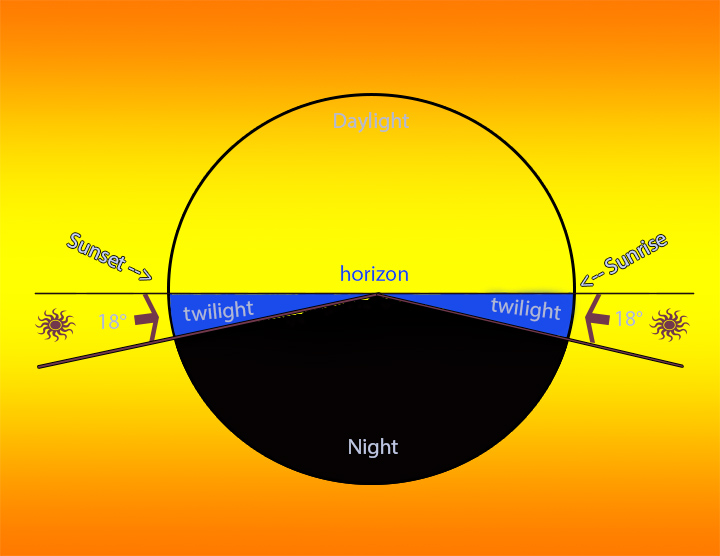
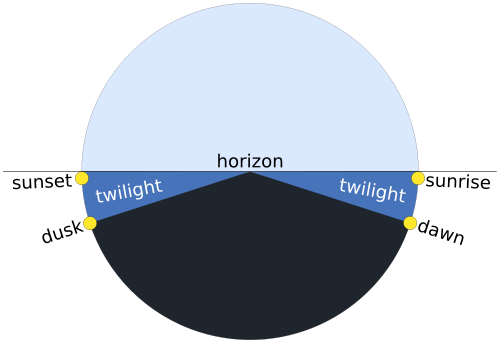
Now, astronomers can calculate when both al-Ṣubḥ al-Ṣādiq and the setting of the white twilight occur. They do this by calculating the angle between the centre of the Sun's disc and the horizon. Now, for most regions of the world, the angle at which both al-Ṣubḥ al-Ṣādiq and the setting of the white twilight occur is 18°, i.e. both al-Ṣubḥ al-Ṣādiq and the setting of the white twilight occur when the centre of the Sun makes an angle of 18° with the horizon. These two diagrams both illustrate it well.


Going back to all those different calculation methods, the reason there are several calculation methods on your app is because several institutions have determined different angles at which both al-Ṣubḥ al-Ṣādiq and the setting of the white twilight occur, based on which figures they deem most correct. For example, the "Egyptian General Authority of Survey" method has Fajr and ‘Ishā’ start when the Sun's centre is 19.5° and 17.5° respectively below the horizon, while the "Muslim World League" method has ‘Ishā’ start at an angle of 17°. Although these figures may be used for certain parts of the world, they can't be used for all – Sydney definitely included. Meanwhile, the only calculation method out of the whole lot that has both al-Ṣubḥ al-Ṣādiq and the setting of the white twilight occur at 18° is the "University of Islamic Sciences, Karachi" method. Accordingly, this is the one you should configure your prayer app to.

‘Aṣr Method

So you might be asking: why are there two different ‘Aṣr calculation methods?

It all goes back to the difference of opinion amongst the fuqahā’ (jurists) on when the time for ‘Aṣr enters. According to the Mālikī, Shāfi‘ī, and Ḥanbalī schools, ‘Aṣr time starts when the length of an object's shadow, in addition to the length of its shadow at the time of zawwāl, equals the object's height. However, according to the Ḥanafī school, ‘Aṣr time starts when the length of an object's shadow, in addition the length of its shadow at the time of zawwāl, is double the object's height. For example, say we stood up a 30 cm ruler on the ground outdoors and its shadow at the time of zawwāl was 5 cm. According to the majority opinion, ‘Aṣr would start when the shadow of the ruler reaches 35 cm in length (30 cm + 5 cm), while according to the Ḥanafi opinion, ‘Aṣr would start when the shadow of the ruler reaches 65 cm in length ((30 cm × 2) + 5 cm).

As such, there are two methods for calculating ‘Aṣr, depending on which opinion you follow.

Minutes Adjustment

So you might be asking: why do I need to adjust the minutes for Ẓuhr and Maghrib?

Let's address Ẓuhr first. Ẓuhr is defined as starting when the Sun begins to decline from its zenith (i.e. its highest point in the sky for the day). Now, the thing with your prayer app is that when it comes to Ẓuhr, it actually calculates the time when the Sun is actually at its zenith, not when it begins to decline from it. This can be problematic: it is actually ḥarām/makrūh taḥrīman, and therefore sinful, to offer ṣalāh when the sun is at its zenith. Furthermore, since Ẓuhr time starts when the Sun declines from its zenith, if one were to therefore begin praying right when the Sun is at its zenith, one's prayer would be invalid as one began performing it before its time. The same applies with the pre-Ẓuhr sunnah prayers.

Obviously, what all that means is that we need to wait a few minutes after the Sun reaches its zenith before we can pray Ẓuhr. Now, long story short, the Sun can be said to first decline from its zenith 65 seconds after reaching its zenith. Round that forward to the next minute and you get two minutes. (Yes, we round to the next minute here, not the nearest minute - try figuring out why.) However, an extra one minute should be added as a safety factor, for various reasons. Thus, the Ẓuhr time on your prayer app should be adjusted so as to reflect this. Adding three minutes to the time calculated by your app is the minimum, though it is safer to add at least five minutes, as recommended by various scholars and Islamic authorities.

As for Maghrib:

"Maghrib should be calculated at least as 3 minutes after theoretical sunset (reported in newspapers) for the following considerations:

1. The effects of actual humidity, temperature, and pressure in the atmosphere may cause a different refraction of sun light than assumed in calculations of theoretical sunset.
2. In some areas there could be a downward sloping ground towards western horizon that causes a delayed sunset for an observer compared to a perfectly level ground as assumed in calculations of theoretical sunset.
3. For major metropolitan cities, the sunset in a 30 mile (approx. 48 km) radius from the point assumed in calculation will vary. Since the people may live all around the city, this may delay sunset for some areas." (Adapted from moonsighting.com)

A VERY IMPORTANT NOTE ON ‘ISHĀ’

Earlier, we stated that the time for ‘Ishā’ starts when the white twilight that trails the setting Sun disappears below the horizon. However, there is actually a significant difference of opinion amongst the fuqahā’ on this matter (just like there is for ‘Asr prayer). The difference of opinion relates to whether ‘Ishā’ starts with the disappearance of the white twilight (al-Shafaq al-Abyaḍ) or the red twilight (al-Shafaq al-Aḥmar).

The implications of this difference opinion are quite significant: for those who hold that ‘Ishā’ time enters with the disappearance of the red twilight, whatever was mentioned about the University of Islamic Sciences, Karachi calculation method being the correct method to use now falls flat on its face, as this method (the other methods likewise) works on the basis that ‘Ishā’ time enters with the disappearance of the white twilight. Not only that, but the majority of the schools of fiqh actually hold the red-twilight opinion to be the correct and relied-upon opinion.

This dilemma will be dealt with in more detail in the upcoming post, in shā’ Allāh.

In shā’ Allāh, this has clarified some confusion with regards to all those settings on your prayer app. If not, please do not hesitate to reply and ask.

We ask Allah to make us of those who guard their prayers, both in quantity and quality.
And Allah knows best, and with Allah lies ultimate success.
Monday, 11 January 2016

"Why Are You Muslim?" – Part II

Bismi llāh, wa l-ḥamdu lillāh, wa ṣ-ṣalātu wa s-salāmu ‘alā rasūli llāh, sayyidinā Muḥammadini bni ‘Abdi llāh, wa ‘alā ālihī wa ṣaḥbihī wa man wālāh. Ammā ba‘d:

This part deals with proving the Qur’ān to be the Word of God and thus the truthfulness of Prophet Muḥammad's (ﷺ) claim to prophethood. (Note that some of the below is copy-paste; I've placed a reference list at the bottom of sources from where I've done this. I may try properly tracing back each quote to its source another time in shā’ Allāh.)

Going Back a Bit

Previously, we proved God's existence: that He definitely exists, He is One and Only, and that He is beyond all need and limitation. But since He created us, does He demand anything from us? Or did He create us purposelessly? To answer this, one would analyse the claims of all religions that call to belief in one god and see if they hold merit. If none of them do, then it could be that God doesn't demand anything from us. Or is it?

With most religions that call to one god, their claims to one god are flawed. They are all unable come up with sufficient proof to back up their claims as being the "true religion". From Christianity (with its unsound approach to "one" god) to Sikhism (which has no idea how to prove that its teachings indeed came from God – pretty much like every other religion), none are able to rationally prove the correctness of their religions.

Except Islam that is.

Tuesday, 22 December 2015

"Why Are You Muslim?" – Part I

Bismi llāh, wa l-ḥamdu lillāh, wa ṣ-ṣalātu wa s-salāmu ‘alā rasūli llāh, sayyidinā Muḥammadini bni ‘Abdi llāh, wa ‘alā ālihī wa ṣaḥbihī wa man wālāh. Ammā ba‘d:

"Why are you Muslim?"

It is very important, especially in our day and age, that we be able to confidently answer this question. Answers such as "I was just born into a Muslim family", "It makes me feel good", "Well, that's what I grew up with", and the like don't quite cut it. Faith based on blind-following, emotions and feelings can very shaky. We're not saying that feeling good about the religion is blameworthy, or that following what your parents taught you about Islam is all bad. The problem arises when these become the main/only reasons as to why you are a Muslim, i.e. if you're Muslim just because of these reasons.

What is needed is an intellectually satisfying answer to this question. The answer has to make sense to the mind. It's got to be rational and logical, not merely emotional. Emotions fickle and fluctuate – one day, you might be feeling all happy and gleeful about God and religion; next day, you could be in a crisis of faith, doubting God and having hostile feelings about religion. Hence, emotions cannot serve as a solid foundation for faith – that would be like constructing a building on the edge of the sea, with all those tidal waves constantly hitting at its foundations. Rather, the foundation for faith must be intellectual and rational, because once you're rationally convinced of an idea – once you're sure that an idea just makes so much sense that following any other alternative would be an insult to your intelligence – no one can shake you away from it.

Now, the question of "Why are you Muslim?" can be split into two main parts:

1) Proof that God exists.
2) Proof of the messengership of Muḥammad (ﷺ) and how the Qur’ān is the Word of God.

In shā’ Allāh, this post will address the first part. The second part will be addressed in an upcoming post, in shā’ Allāh.

Friday, 18 December 2015

Displeasure with the Divine Decree

Displeasure with the divine decree occurs when one resists
God, the Majestic and Exalted, in what He has decreed.

For instance, saying, “I did not warrant this happening to
me!” or “What did I do to deserve this suffering?”

Discussion

The Imam speaks next of “displeasure with the divine decree,” a phenomenon that should ring familiar. How many times have we heard a person bemoan, “I do not deserve this!” or “Why me?” or utter such similar statements? Many people live with rancor in their hearts because of what they have been dealt with in life. This attitude toward trials stems from a denial of God’s omnipotence and that God alone decrees all things. We cannot choose what befalls us, but we can choose our responses to the trials of life, which are inevitable. His decree is but a command from Him: “‘Be’ and it is!” as is repeated in the Qur’an (2:117, 3:47, 6:73, 16:40, 19:35, 36:82, 40:68). Imam Abū Ḥasan said that there is a quality in people that most are unaware of, yet it consumes good deeds: displeasure with God’s divine decree (qadar).
     God-conscious people, when asked about what their Lord has given them, say that all of it is good. They say this out of knowledge of the nature of this world, as a temporary crucible of trial and purification. Because of this elevated understanding, they are patient with afflictions and trials. For worldly people, there is only this world, and this understanding creates a blind spot to the wondrousness of God’s creation and His signs strewn throughout.
     There are only four possible states in which the human being can live, according to revealed sources. A person is either receiving blessings (niʿmah) or tribulations (balā’) from God; or is either living in obedience (ṭāʿah) to God or in disobedience (maʿṣiyyah). Each condition invites a response. When God bestows blessings, the response should be gratitude in all of its manifestations. According to sacred law, gratitude is expressed first by performing what is obligatory (wājib), and then going beyond that by performing virtuous, recommended (mandūb) acts. Gratitude is an awakening of appreciation in one’s heart and an acknowledgement of what one has received. Abusing one’s material assets (hoarding them without consideration of the needy or applying them toward forbidden matters) is a flagrant act of ingratitude.
     The response to tribulation is patience (ṣabr), as well as steadfastness and resolve. This is what God demands from people in times of trial—“a beautiful patience,” as close as possible to the what Jacob (may peace be upon him) exhibited in response to the disappearance of his beloved son Joseph (may peace be upon him) and the machinations of his other sons (qur’an , 12:18), or to the patience of Job (may peace be upon him) during his afflictions.
     As for obedience, one must recognize that obedience is a blessing from God. If a religious person starts to believe that he is better than other people—even if these “other” people are in the state of disobedience—he invites haughtiness. This is the danger of obedience and, in fact, the danger of religion: self-righteousness. Imam Ibn ʿAṭā’allāh said, “How many a wrong action that leads to a sense of shame and impoverishment before God is better than obedience that leads to sense of pride and arrogance!” In this is the secret of wrong actions. The New Testament relates the story of the pride of the righteous Pharisee and the contrition of the humble tax collector. Jesus (may peace be upon him) remarks, “Those who make themselves great will be humbled, and those who humble themselves will be made great.” Sīdī Aḥmad Zarrūq said that the goodness in obedience is in its essence, and the evil in obedience is what it can result in. This does not mean that there is evil in obedience and goodness in disobedience. Rather, Sīdī Aḥmad Zarrūq points out the danger of obedience creating vanity in one’s heart, an aura of sanctimony and condescension. On the other hand, when one indulges in wrongdoing and is overcome with feelings of shame, this can inspire him to hasten to repentance. The Prophet ﷺ said that he feared for his people the vanity of self-righteousness.
     The Prophet ﷺ also said that whoever has a mustard seed of arrogance in his heart will not enter Heaven; this sentiment is shared with Christianity. What God asks from obedient people is simply acknowledging that their obedience is a gift from God. The Prophet ﷺ said, “Do not find fault in others. If you find fault in them, God may take their faults away and give them to you.” It is unbecoming for a believer to look with scorn at those in tribulation and exhibit a loathsome disdain toward others who seem misguided. It is far better to come with compassion toward them and gratitude to God. When the Prophet ﷺ saw people severely tried, he made the supplication: “Praise be to [God] who has given me wellbeing such that I was not tried like these people. And He has preferred me over so much of his creation.” When the Prophet ﷺ witnessed people in tribulation, he responded with compassion for them and gratitude for wellbeing.
     When it comes to disobedience (maʿṣiyyah), the correct response is sincerely repenting to God (tawbah); seeking His forgiveness, pardon, and mercy; feeling remorse for past sins; and having the resolve never to sink into disobedience again.
     Everything that can happen to a person falls into one of these four categories, and each invites an appropriate response. What comes to a person in his or her life may help a person move closer to God when the response is right: “It may be that you dislike something, though it is good for you. And it may be that you love something, though it is bad for you. And God knows, and you do not know” (qur’an , 2:216). Ibn ʿAbbās said that if a person is tested with a tribulation, he will find in it three blessings: firstly, the tribulation could have been worse; secondly, it was in worldly matters and not in spiritual ones; and thirdly, it came in the finite world and not the infinite one. All these are reasons to thank God even for tribulations.
     It is important to look at the life of the Prophet ﷺ and to recognize that no one faced greater tribulation. The Prophet ﷺ lived to see all of his children buried, except for Fāṭimah (may God be pleased with her). How many people experience that in their lifetime? Out of six children, he saw five of them perish. His father died before his birth. His mother died when he was just a boy. His guardian grandfather then died. When he received his calling, he saw his people turn against him with vehemence and brutality. People who had once honored him now slandered him, calling him a madman, liar, and sorcerer. They stalked him and threw stones until he bled. They boycotted him and composed stinging invectives against him. He lost his closest friends and relatives, like Ḥamzah (may God be pleased with him). After 25 years of blissful marriage, his beloved wife, Khadījah (may God be pleased with her), died during the Prophet’s most trying times. Abū Ṭālib, his protecting uncle, also died. The Prophet ﷺ was the target of thirteen assassination attempts. How many people have faced all of that? Not once in a single hadith is there a complaint from him— except when beseeching his Lord.
     To be displeased at God’s divine decree is to plunge into heedlessness (ghaflah). In his book al-Furūq, Imam al-Qarāfī distinguishes the difference between a divine decree and being content with the decree itself. Should people be happy with all that comes their way, including the bad things? God has decreed that evil exist in the world in order to test humankind and for reasons that accord with His wisdom. We should not be displeased with His choice in allowing this. But when one sees societies plunged into immorality, it is not something to be pleased with or even to feel indifferent toward. On the contrary, God requires that we dislike it. But never should we resent or be displeased with the fact that God has created a world wherein such things exist, however unpleasant they may be. As Ibn ʿAbbās said, every trial could have been worse, such as if it involved one’s worldly affairs rather than religion, and if it came in this world and not the Hereafter, which lasts forever.
     Imam al-Qarāfī gives the example of a physician who amputates the arm of a patient who had gangrene spreading out of control. One day, the physician overhears the patient complaining that the physician was ignorant for amputating his arm. The physician is offended, for he saved the man’s life. Had the physician heard the patient praising him—despite the fact that he lost an arm and is discomforted by pain—the physician would feel compassion for the man. So if one speaks about God’s decree, saying, “God is testing me, but it is His will and there is wisdom in it,” this differs greatly from the remarks of one who complains about the perceived injustices in the world.

[From the book Purification of the Heart: Signs, Symptoms and Cures of the Spiritual Diseases of the Heart, pg. 79-83, by Hamza Yusuf]